
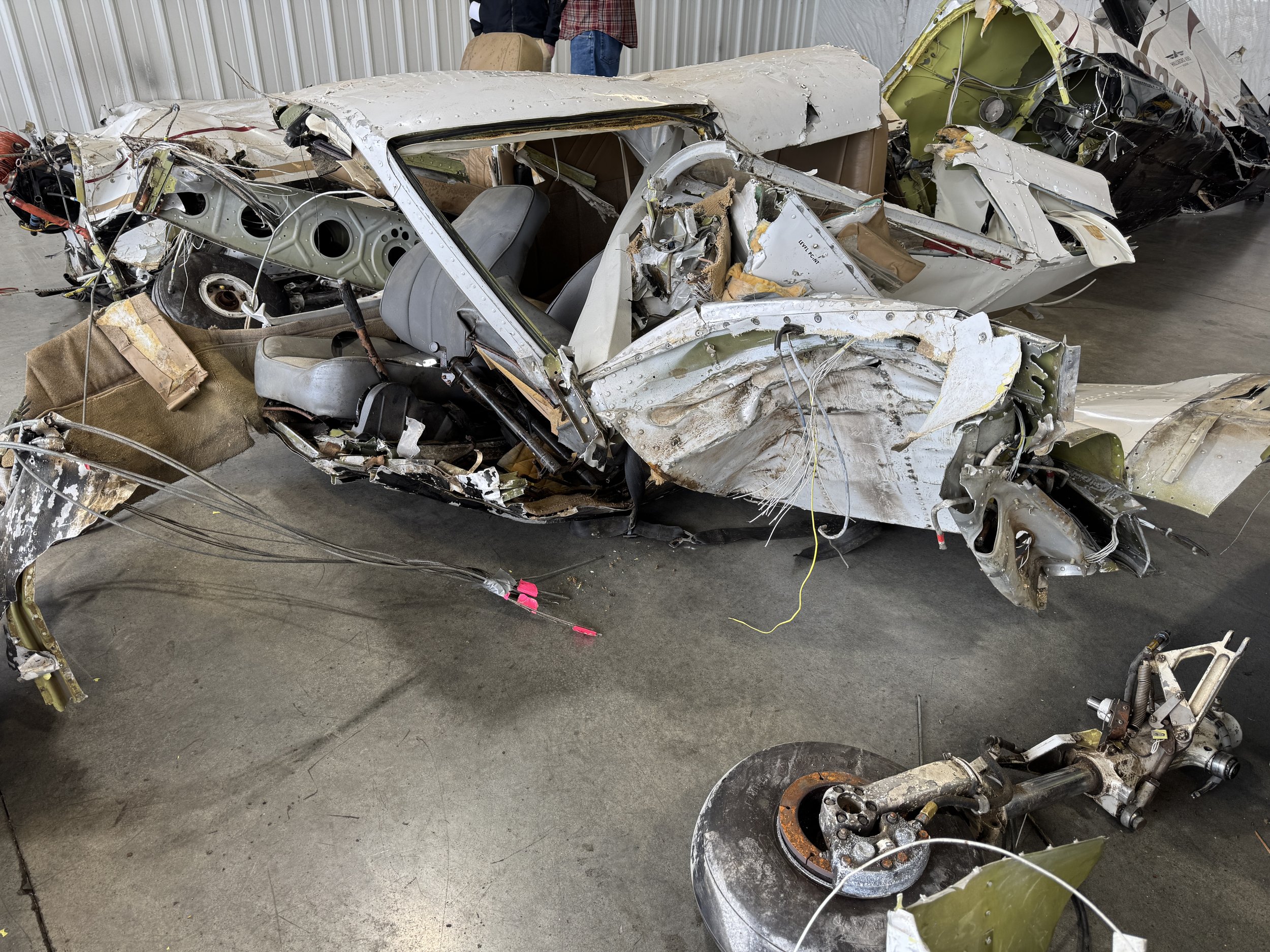
Aircraft Wreckage Documentation and Inspection
In an NTSB-investigated accident, the Board controls the scene. By the time counsel retains an expert, the aircraft has been recovered to a secure facility and the on-scene record exists only in the Board’s photographs, diagrams, and field notes. Effective examination therefore rests on two things: reading what the recovered wreckage still shows, and understanding what the on-scene documentation does and does not capture.
A Staged Examination
Wreckage examination is rarely a single event. An initial examination of the complete recovered wreckage establishes overall condition, documents the airframe as received, and identifies the components that warrant closer study. Those components are then segregated and preserved for laboratory examination, where computed tomography, nondestructive testing, materials analysis, and controlled disassembly can resolve questions the visual examination raised but could not answer.
Multiple examinations across a single matter are common. Each stage narrows the question, and each carries its own documentation requirements, protocol agreement among the parties, and chain-of-custody discipline.
Scope of Examination
• Initial examination of the complete recovered wreckage, including airframe, powerplant, and systems
• Documentation of as-recovered condition prior to any disassembly or component removal
• Identification and segregation of components warranting laboratory examination
• Coordination of laboratory work, including computed tomography, non-destructive testing, and materials analysis
• Controlled disassembly and documented teardown of engines, accessories, and flight control components
• Identification of pre-impact versus post-impact damage signatures
• Determination of flight control continuity, including cable runs, bellcranks, and push-pull tubes
• Assessment of impact attitude and breakup sequence from surviving structure
• Correlation of recovered evidence against NTSB on-scene photographs, diagrams, and field documentation
Reading Wreckage After Recovery
Recovery is not a neutral process. Cutting, lifting, and transport introduce damage that must be separated from impact damage, and components are routinely removed from their installed positions before an expert ever sees the aircraft. Examination has to account for recovery-induced damage explicitly rather than treating the wreckage as found condition. Distinguishing the two is often where the analysis is won or lost.
Joint Inspection and Evidence Preservation
Wreckage examinations in litigation are commonly conducted jointly, under agreed protocols, with counsel and experts for multiple parties present. Mr. Rexwinkle works within those protocols: documenting condition before any disassembly, coordinating destructive and invasive testing where it is required, and preserving the record needed to defend the examination and its conclusions later.
Experience
Mr. Rexwinkle has examined and documented wreckage across more than 300 aviation mishaps since 2008, and has authored over 100 expert reports and technical memoranda. He has testified in deposition and at trial and accepts engagements from both plaintiff and defense counsel nationwide.